Finished reading: Crossing the Wine-Dark Sea: Journeys Through Ancient Literature by Emily Wilson 📚
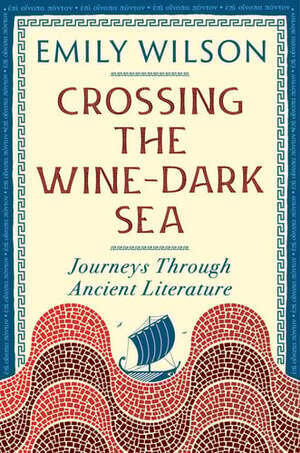
Finished reading: Crossing the Wine-Dark Sea: Journeys Through Ancient Literature by Emily Wilson
I’m not quite sure how to review this book properly. It wasn’t what I expected, but it did offer enough of what I hoped to read and learn.
At its heart, the book is about translation and the difficult choices translators must make, many of which readers may never consider. A translator’s background and life experience inevitably shape their work.
I learned several new terms and how they apply to translation:
- False homogeneity names the misleading uniformity that can arise when diverse literary traditions are read in English translation as if they belonged to a single familiar culture. The term marks a critical warning against translations that smooth over difference and make foreign works seem comfortingly alike.
- Hermeneutics denotes the interpretive tradition associated here with Friedrich Schleiermacher, described as the father of modern hermeneutics. In this usage, it is tied to translation theory and to the idea that translation should be “foreignising,” preserving the strangeness of the source text rather than smoothing it into familiar English.
- A monoglot is a reader or speaker limited to one language. The term is used to describe English-speaking minds and lives that translation can open to foreign viewpoints, unsettling assumptions of familiarity and broadening awareness of other human possibilities.
I’ve taken a few classes in Greek translation, so I had a small foundation to build on. Still, the author opened my eyes to much more, including Roman literature:
In the mode of Father Brown, we should learn to notice and be amazed by the obvious facts about Roman literature that are all too easy to take for granted. There are three interrelated well-known facts. The first is that the Romans wrote literature at all—something that was by no means inevitable, since many thriving cultures, ancient and modern, have not done so. The second is that they learned Greek, the language of a people they had conquered. The third, which does not follow from the second, is that they also translated Greek literature into Latin, and imitated Greek literary models—an action unparalleled in the ancient world.
It’s easy to overlook how much of what we read is made possible by translators’ hard work. But it’s also worth recognizing translation’s limits and risks. Translation is far from perfect: mistakes happen, and there is no single correct translation.
Mistakes are possible in translation, as every language instructor knows. But there is never a single ‘correct’ translation of a specific word, phrase, sentence, or passage.
On the one hand, without translation, most of us would have little or no access to most of the literary wealth of the world. Translation allows us to cross linguistic boundaries and opens our eyes to entirely different cultural experiences and forms of literature. I feel deep gratitude to the translators who have enabled me to read Korean, Japanese, Arabic, Hebrew, Sanskrit and Swedish literature, among others, given that I will not have time to learn any of these languages in the limited number of years I am likely to remain alive.
The author explores this in depth, comparing translations of several passages to show how much they can differ. A translator may change a paragraph’s meaning and substance with good intentions: to make it flow for the modern reader, or for a hundred other reasons. In doing so, they can stray from the original language and the way its words were used at the time.
One book on my to-read list is The Vegetarian, and I hadn’t known about the controversy involving its translator:
In 2016 the International Booker Prize was awarded for the first time to a single novel, The Vegetarian, which was translated from the Korean. The award was shared by its author, Han Kang, and its translator, Deborah Smith. Kang and Smith are friendly collaborators, and Smith has translated Kang’s subsequent work. But the translation aroused controversy in late 2017 when Korean readers accused Smith of not knowing the language well enough to render it responsibly, supposedly producing an English version that is not really a ‘translation’ at all.
If you’re interested in translation and its challenges, this book is well worth reading. If you’re an avid reader who hasn’t explored the subject before, it’s a good place to start. It offers useful context for reading translated books more carefully and for understanding why you might want to try a different translator’s version of the same work.
288 pages · First published 2026
I'd love to hear your thoughts or suggestions! Please share your comments below: