
The rush: California gold, the Civil War, and the making of the modern world
My posts about this book
Finished reading: The Rush: California Gold, the Civil War, and the making of the Modern World by Nathaniel Philbrick 📚
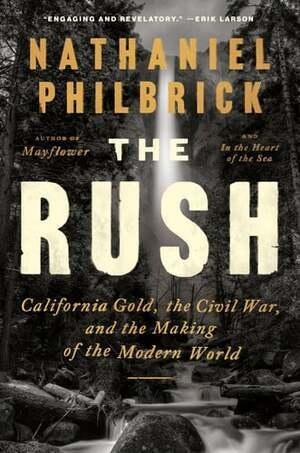
Finished reading: The Rush: California Gold, the Civil War, and the Making of the Modern World by Nathaniel Philbrick
This is an excellent book about the 1848 California Gold Rush, a discovery whose ripple effects touched almost everyone. It goes well beyond the gold fields to explore the social, economic, and political upheaval that followed the discovery at Sutter’s Mill.
Most of all, however, gold is rare. If all the gold ever found in the world was assembled in one place, it would fill just three and a half Olympic-size swimming pools.
I enjoyed 80% of the book, but I ultimately had to skim the rise and fall of all the political characters and their shenanigans. My interest wanes very quickly with that level of political detail. It’s fascinating, and if you are a political junkie, you will really enjoy that section of the book.
The history of San Francisco and Sacramento was a highlight for me. San Francisco’s boom-and-bust cycles and fires alone could fill a whole book.
One Frenchman’s view of San Francisco:
Russailh had been in San Francisco only a few months, and he didn’t know what to make of the Americans. With little provocation, they would draw their revolvers and start shooting at one another, cheered on by delighted passersby. “I often wonder if this great people will revert altogether to barbarism,” Russailh wrote. “Perhaps the unrestrained liberty flourishing in the United States has stifled every spark of civilization and honor…. The whole town stinks of degradation.”
I hadn’t understood the full reach of the Gold Rush, especially its connection to South America.
The numbers put the scale of it into perspective: Chile had 119 registered ships at the time, and 92 ended up in San Francisco Bay. Many never returned. Chile’s presence was unmistakable, with Chilean goods supplying San Francisco’s thriving restaurants and hotels.
Plenty of people got rich without ever setting foot in the gold fields. I think they were the smartest of the bunch. They sold supplies, ran boarding houses, or bought property at crazy low prices from people desperate to fund supplies and get out to stake a claim.
On the political side, the book digs into the fight for statehood and the battle over slavery.
It never ceases to amaze me how cruelly people can treat their fellow human beings. The treatment of the Indigenous peoples was heartbreaking and, at times, very hard to read.
But what did even more to stifle the freedoms created by California’s constitution was the statute regarding the testimony a person of color was allowed to give in court. “No black, or mulatto person, or Indian,” it read, “shall be permitted to give evidence in favor of, or against, any white person.” Unable to testify on their own behalf when it came to the abuses inflicted on them by white Americans, Black and Native people were rendered virtually powerless before the courts.
“Any Indian…found loitering and strolling about…,” the law read, “shall be liable to be arrested on the complaint of any resident citizen of the county.” If found guilty—and since Indians (along with African Americans) were not allowed to defend themselves, this was more than likely to be the case—the offending party was to be “hire[d] out…within twenty-four hours to the best bidder.”
Sam Brannan seems to have had the Church figured out:
Sam Brannan never forgave Brigham Young for abandoning him in California. With the discovery of gold, he seems to have undergone a secular conversion. From then on, he would devote himself not to the faith of Joseph Smith, but to the pursuit of wealth and pleasure. When Brigham Young sent a messenger to San Francisco demanding “a present of $20,000 in gold dust to the Lord,” Brannan had a message of his own for the Mormon leader: “Tell Brigham I’ll give up the Lord’s money when he sends me a receipt signed by the Lord.”
Then:
Brigham could not permit such a flagrant breach of church discipline to remain unpunished. Flock after flock of “destroying angels” took flight from Salt Lake City, duly commissioned to bring back Samuel’s scalp or perish in the attempt.
What a nice group of people. The Lord at work.
You’ll learn how Yosemite Valley got its name and the valley’s dark history and cruel treatment of the people living there at the time.
John Ridge wrote The Life and Adventures of Joaquin Murieta, the first novel published by a Native American, which eventually was used as the basis for Zorro in 1913.
Relating to Photography:
In most parts of the country, daguerreotypes were confined to studio portraits—but not in California. People in the East were desperate to know what the Gold Rush looked like. Photographers (a term barely a decade old) began to venture far from their studios to produce a vast array of en plein air daguerreotypes. As a result, the California Gold Rush marked the first time photography had been used to visually document a major historical event. Images of miners in the goldfields, of the streets of San Francisco, and of the wonders of the Yosemite Valley circulated throughout the United States and the world.
If this time period interests you, you can’t go wrong with this deep dive into a remarkable time period.
452 pages · First published 2026